Can breast shape and upper-pole fullness be improved without implants? For suitable patients, modern own-tissue techniques offer another route.
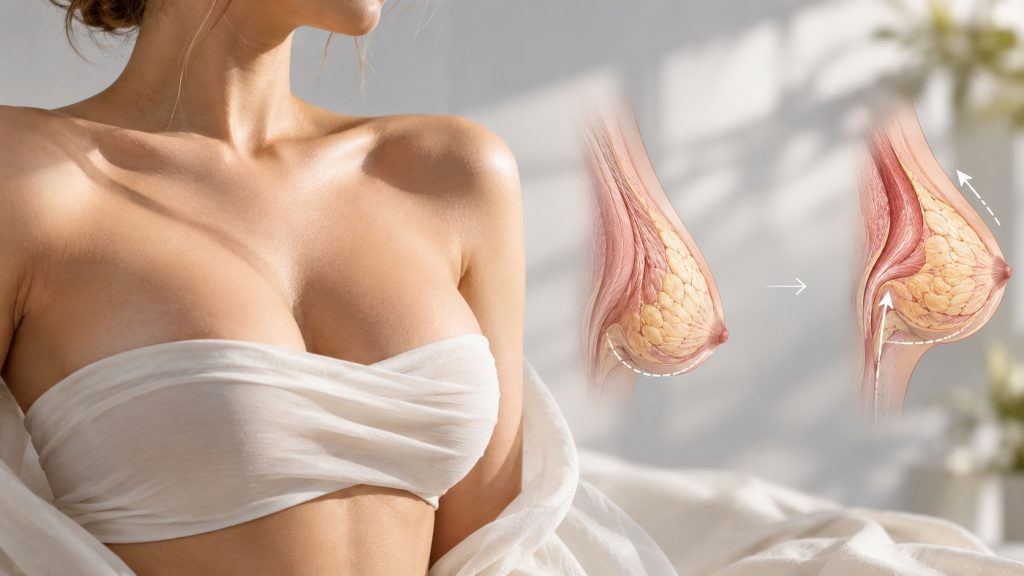
Breast aesthetics is often discussed as though there are only a few familiar choices: a breast lift, an implant, or a combination of the two. In practice, that picture is incomplete. For some patients, the breast tissue they already have can become part of the solution.
This can be particularly relevant after pregnancy, breastfeeding, weight changes or ageing, when the breast may have enough natural tissue but has lost its former position or upper-pole fullness. Rather than adding volume with a foreign material, certain surgical techniques reshape and reposition the existing tissue.
How Can Breast Shape Be Improved Without Implants?
It helps to separate two goals that are easily confused: lifting the breast and adding volume. A mastopexy, commonly known as a breast lift, mainly addresses sagging and reshapes the breast. An implant, on the other hand, introduces additional volume and can increase projection. Some patients want a lifted shape and more fullness, yet would prefer not to have an implant.
Own-tissue, or autologous, approaches are relevant here. Instead of depending only on skin tightening, the surgeon can make purposeful use of breast tissue that is already present. That tissue may be reshaped and repositioned to contribute to contour, projection and internal support.
What Does Using Your Own Breast Tissue Actually Mean?
In simple terms, “autologous” means tissue from your own body. Within breast aesthetics, the idea is to work with suitable natural breast tissue rather than introducing an artificial device as the source of volume.
Consider a breast with adequate tissue in its lower portion but noticeably less fullness above. In selected techniques, that lower-pole tissue does not have to be viewed simply as tissue that needs lifting or reshaping. It may also provide useful internal volume when repositioned.
This own-tissue philosophy is also central to pureown, where implant-free breast aesthetics is approached through the reshaping and redistribution of a patient’s existing tissue. Of course, having natural breast tissue does not automatically make someone suitable for this type of surgery; individual anatomy remains a deciding factor.
Why Does Upper-Pole Fullness Matter?
The upper pole is the area between the upper chest and the fuller central part of the breast. When breast tissue descends after pregnancy, breastfeeding, weight fluctuations or ageing, this area can lose volume and begin to look flatter.
So, when surgeons talk about upper-pole fullness, they are not necessarily talking about making the whole breast larger. They are referring to how volume is distributed in the upper portion of the breast.
A conventional breast lift can improve position and overall shape, but the degree of upper-pole fullness that can be achieved varies with anatomy and surgical technique. This is one reason different autoaugmentation methods have been developed: they allow existing breast tissue to be redistributed rather than simply lifted.
What Is Autoprosthesis?
The name is technical; the principle behind it is easier to understand. “Auto” refers to the patient’s own tissue. “Prosthesis” describes the role that tissue takes on after it has been shaped and repositioned as an internal source of volume and support.
Autoprosthesis is therefore more specific than simply performing a breast lift. The available breast tissue is deliberately used to contribute to projection, contour or structural support during reshaping.
How Does Dual-Plane Autoprosthesis Work?
Dual-Plane Autoprosthesis takes this concept a step further. An inferior dermoglandular pedicle created from the patient’s own breast tissue is repositioned into the subpectoral plane, beneath the pectoralis major muscle. The repositioned tissue is intended to contribute to upper-pole volume while also benefiting from muscular support.
This differs from techniques that simply fold or reshape tissue within the same anatomical plane. Here, the tissue is redistributed between anatomical planes and effectively becomes a biologic internal volume structure.
Readers who want to examine this anatomical concept in greater detail can explore the Autoprosthesis approach, including how lower-pole tissue is repositioned and supported. It should still be viewed as a surgical option for selected patients, not as a universal substitute for implants or a technique that produces identical results in every body.
Implant-Based and Implant-Free Breast Aesthetics: What Is the Difference?
The clearest difference is the source of volume. Breast augmentation with implants adds volume through an implant. An own-tissue procedure works with breast tissue that is already available and redistributes it.
That distinction does not make one approach automatically better than the other. They address different needs, and what can realistically be achieved varies with breast size, tissue quality, degree of ptosis and the result a patient hopes to achieve.
- Implant-based augmentation: adds breast volume using an implant.
- Own-tissue autoaugmentation: reshapes and redistributes the volume already present in the breast.
- Standard mastopexy: primarily lifts and reshapes sagging breast tissue.
- Autoprosthesis-based mastopexy: combines lifting with strategic tissue repositioning to contribute to volume and internal support.
There is a practical difference too. If no breast implant is placed, implant-specific problems such as implant rupture, capsular contracture or the need for future implant exchange do not apply. This should not be mistaken for “risk-free surgery.” Implant-free procedures have their own surgical risks, limitations and recovery considerations.
Who May Consider Implant-Free Breast Aesthetics?
Wanting breast surgery does not always mean wanting larger breasts. Some women are comfortable with the amount of breast tissue they have, but are unhappy with sagging, reduced upper fullness or changes in shape following pregnancy or weight loss.
For these patients, preserving and redistributing existing tissue may be something to discuss with a qualified plastic surgeon. Women with breast ptosis, enough natural breast tissue and a preference to avoid silicone implants may be potential candidates, depending on their individual anatomy.
Expectations are just as relevant as tissue availability. A patient looking for a substantial increase in overall breast size is asking for something quite different from a patient who mainly wants existing volume moved into a better position.
Is Everyone Suitable for Autoprosthesis?
No. There needs to be enough appropriate tissue to work with.
If the breast contains very little usable tissue, a surgeon cannot create unlimited volume simply by rearranging it. The amount and quality of tissue, skin characteristics, breast dimensions, degree of sagging and the patient’s desired result all affect what can reasonably be achieved.
General health and medical history matter as well. Online information and before-and-after photographs can help someone understand the idea behind a technique, but they cannot establish whether it is suitable for a particular person. That requires an individual surgical assessment.
Can Upper-Pole Fullness Be Created Without an Implant?
Yes, in suitable anatomy it may be possible to increase upper-pole fullness by repositioning existing breast tissue. Rather than adding another source of volume, an autoaugmentation strategy changes where the patient’s own volume sits.
With the Dual-Plane Autoprosthesis concept, tissue from the lower pole is shaped and transferred into a subpectoral position. The pectoralis major muscle then becomes part of the anatomical support environment around that repositioned tissue. The aim is to create more upper-pole projection using the patient’s own breast tissue.
This is an important distinction when researching Implant-Free Breast Aesthetics. “Implant-free” does not merely describe the absence of an implant; it can also refer to a surgical plan built specifically around preserving, repositioning and supporting natural breast tissue.
PureOwn and the Own-Tissue Approach to Breast Aesthetics
PureOwn centers on the Zereyak Autoprosthesis approach, which uses the patient’s own breast tissue rather than silicone to create upper-pole fullness during breast reshaping. Within its Dual-Plane concept, lower-pole tissue is placed in a subpectoral position, allowing that repositioned tissue to contribute to volume and internal support.
One useful way to understand the approach is to separate two goals that patients sometimes group together. Wanting bigger breasts is not necessarily the same as wanting the breast volume you already have to sit differently. For someone primarily concerned with shape and volume distribution, that distinction can materially change the discussion about surgical options.
The technique has also been described in peer-reviewed medical literature. Published experience with a surgical method, however, cannot predict an individual patient’s outcome. Natural breast tissue continues to change over time, and factors such as ageing, gravity, pregnancy and weight fluctuation remain relevant after surgery.
Natural Tissue Does Not Mean “No Surgery”
The phrase “natural breast aesthetics” can easily give the wrong impression. Using your own tissue does not make the procedure non-surgical or minor. Autoprosthesis techniques still involve surgery, including tissue dissection, repositioning and reshaping of the breast.
Scarring is part of that conversation too. These procedures are commonly performed together with mastopexy, which requires surgical incisions. The eventual scar pattern depends on the patient’s anatomy and the operative plan.
Recovery varies from person to person. Swelling, temporary changes in breast appearance and restrictions on physical activity can occur while healing takes place. The breast contour also needs time to settle, so what you see very early after surgery should not be assumed to be the final result.
What Should You Ask During a Consultation?
“Can I do this without implants?” is a reasonable first question, but it is not the only one worth asking. A more useful discussion is whether an implant-free procedure can produce the shape and amount of volume you want using the tissue actually available in your breasts.
Useful questions to discuss include:
- How much natural breast tissue is available for repositioning?
- How much upper-pole fullness can realistically be created?
- Will the procedure also require a breast lift?
- Where are the scars likely to be located?
- What are the risks and limitations of the proposed technique?
- How could pregnancy or future weight changes affect the result?
- What alternatives exist if there is not enough own tissue to achieve the desired volume?
A qualified plastic surgeon should be able to explain why a technique may suit your anatomy and, equally, why another approach might make more sense. Understanding those reasons is more useful than choosing surgery because the name of a particular procedure sounds appealing.
Choosing Between an Implant and Your Own Tissue
There is no single choice that fits every patient. Starting breast volume, anatomy and personal expectations make a substantial difference.
If the main objective is a significant increase in breast size, an implant-based procedure may provide possibilities that limited existing tissue cannot reproduce. When the priority is lifting, redistributing existing volume and improving upper-pole contour, an own-tissue approach may be worth considering.
For patients who specifically prefer to avoid foreign material, autoaugmentation and autoprosthesis techniques have broadened the available discussion. The next step is not to choose a procedure from an article, but to understand these differences well enough to discuss realistic options with a qualified specialist.
Frequently Asked Questions
Can a breast lift be performed without implants?
Yes. A breast lift, or mastopexy, does not inherently require an implant. Existing breast tissue can be lifted and reshaped on its own. How much additional upper-pole fullness can be created depends on the patient’s anatomy, available tissue and the technique used.
What is breast autoaugmentation?
Breast autoaugmentation uses a patient’s existing breast tissue to improve shape, projection or fullness. Instead of bringing in an implant as a new source of volume, the surgeon strategically repositions tissue that is already there.
What does autoprosthesis mean in breast surgery?
It refers to using the patient’s own tissue as an internal source of volume or support. The tissue is reshaped and repositioned so that it contributes to the breast contour without acting as a foreign implant.
Can your own breast tissue create upper-pole fullness?
Yes, for appropriately selected patients. Certain autoaugmentation techniques move existing tissue toward the upper portion of the breast. The degree of fullness that can be achieved is limited by the amount and characteristics of the tissue available.
What is Dual-Plane Autoprosthesis?
Dual-Plane Autoprosthesis is an own-tissue technique in which a dermoglandular tissue segment from the lower breast is repositioned into the subpectoral plane. Its purpose is to create upper-pole volume and internal support without a silicone implant.
Is autoprosthesis the same as a silicone implant?
No. A silicone implant is a manufactured device that introduces additional breast volume. An autoprosthesis is formed from the patient’s existing tissue, which means the amount of usable volume depends on the person’s anatomy.
Can very small breasts be enlarged with own tissue alone?
Only to the extent that suitable tissue is available. If there is very little breast tissue to begin with, an own-tissue technique may not provide the increase in volume a patient wants. This is something a surgeon needs to assess individually.
Does implant-free breast surgery leave scars?
Yes. Implant-free does not mean incision-free. When a breast lift forms part of the operation, surgical scars are expected, and their pattern varies according to the amount of reshaping required and the chosen technique.
Can breasts sag again after an implant-free lift?
Yes. Natural breast tissue continues to respond to ageing, gravity, pregnancy and changes in body weight. No breast-lift technique can guarantee that the breast will remain unchanged for life, even when internal-support strategies are used.
Are implant-related complications possible without an implant?
Problems that specifically depend on an implant being present, such as implant rupture or capsular contracture around an implant, do not apply when no implant is used. Implant-free breast surgery still carries general surgical risks and risks related to the particular procedure.
How do I know whether I am suitable for an own-tissue technique?
A surgeon needs to assess your breast volume, tissue quality, skin characteristics, degree of ptosis, medical history and expected result. There is no reliable way to determine suitability from a general description alone; physical examination and individual surgical assessment are needed.
Is implant-free breast aesthetics always more natural-looking?
No, not automatically. Using natural tissue does not guarantee a particular appearance. The final result depends on anatomy, surgical planning, healing and expectations, and implant-based and implant-free techniques offer different possibilities for different patients.
If your goal is a lifted breast with improved upper-pole contour but you would prefer to avoid implants, the key question is what can realistically be achieved with your existing tissue. Discussing that tissue, the available volume and the limitations of each surgical approach with a qualified plastic surgeon is the most useful way to determine which options fit your anatomy and expectations.
What is your reaction to this?
 I liked it
 Wonderful
 Thanks
 Good
Good Hahaha !
 Incredible
 Interesting
 Wrong
Wrong